
ATP Surface Testing
A handheld device swabs the steering wheel, gear selector, door handles, and touchscreen before treatment. It gives a relative light unit (RLU) reading, so we measure the bacteria instead of guessing.
 Engine Repair02
 Transmission Repair03
 Brake Pads Replacement04
 Oil Change05
 Suspension Repair06
 Car Electrical Repair07
 Body Paint08
 Pre Purchase Inspection09
 Clutch Replacement10
 Sanitisation11
 Timing Belt Replacement12
 Wheel Alignment13
 Window Tinting14
 Windshield Replacement15
 Gear Repair16
 Body Shop17
 Radiator Repair18
 Exhaust Repair19
 Injector Cleaning20
 Car Wash21
 Ceramic Coating Service22
 Upholstery Service23
 Car Tyre Change24
 Car Steering Repair
 Audi specialist service
Zenfo Auto Services sanitises every Audi cabin using ATP surface testing, medical-grade fogging, and evaporator decontamination. You get a before-and-after hygiene score, not a vague promise of “fresh air.”
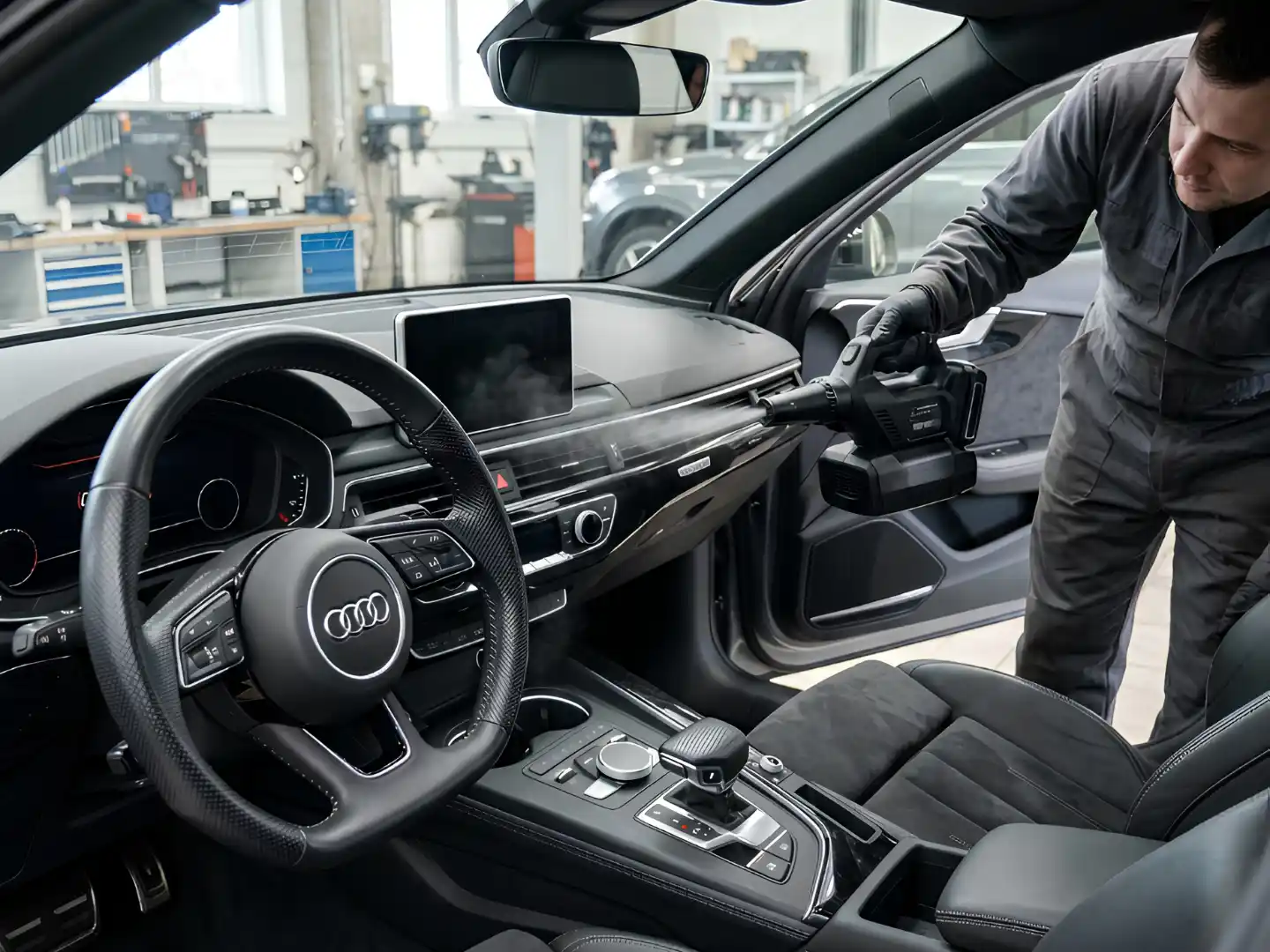
A vacuum and a wipe-down move dirt around. They miss the three places where bacteria and mould actually grow inside an Audi: the evaporator core, the cabin filter housing, and the foam padding under leather and Alcantara. A quick-service wash removes dust from the dashboard and floor mats. But the blower motor still pulls air across a dirty evaporator every time the AC switches on. So the smell, and the bacteria behind it, stay exactly where they were.
The gap gets even bigger once you look at what a wash never opens. Door cavities, sunroof drain channels, and the space under seat cushions stay damp long after the cabin looks dry. None of these spots are part of a standard valet. Our sanitisation starts with the evaporator, the filter housing, and the padding, because cleaning only what you can see leaves the real problem untouched. Then we work outward to every surface a passenger touches.
Mould and bacteria on an evaporator core are invisible from the driver's seat. ATP testing measures adenosine triphosphate, a molecule found in living cells, and turns it into an RLU reading in seconds. A reading under 10 RLU means the surface meets medical or food-contact standards. A reading of 10 to 30 RLU flags moderate contamination that needs attention. Anything above 30 RLU means the surface carries enough bacteria to cause odour and allergy symptoms.
Ozone dosage follows a published standard too. Independent virology research has found a viricidal dose of 10 parts per million sustained for 30 minutes achieves 99 percent viral inactivation. That is why our ozone cycles run to a measured concentration and time, not a fixed timer that ignores cabin size.
A cabin is a sealed, recirculated space for the length of every journey. Whatever grows inside it reaches the driver directly.
These can trigger sneezing, congestion, and eye irritation within minutes of the AC switching on, and the reaction hits children and asthma sufferers harder.
These transfer to your hands on every drive, since these two points get more constant contact than almost any other surface you touch daily.
This is often the first sign of an evaporator problem, and left alone, it spreads mould into the duct network and the cabin filter housing.
A cabin can look spotless and still carry enough bacteria to trigger allergies. Our process covers 14 zones across the ventilation system, the cabin surfaces, and the boot.
A handheld device swabs the steering wheel, gear selector, door handles, and touchscreen before treatment. It gives a relative light unit (RLU) reading, so we measure the bacteria instead of guessing.
We remove the activated carbon filter and check it for compacted dust and mould stains. A clogged filter puts contamination straight back into the cabin within days, no matter how clean the ducts are.
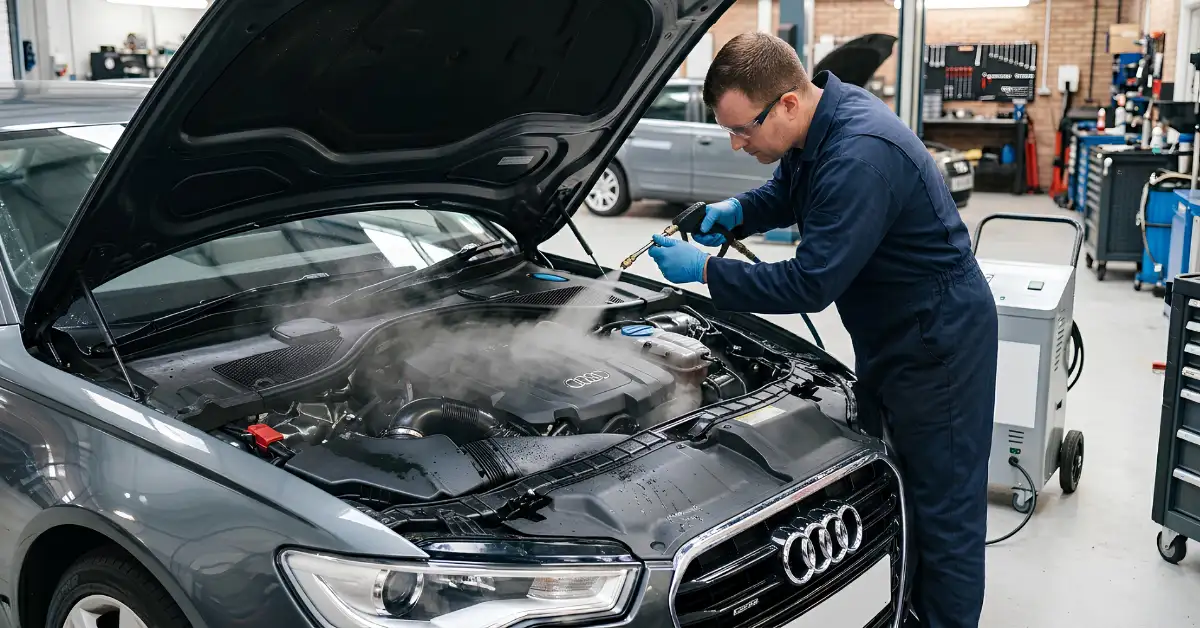
We spray antimicrobial foam through the blower housing to reach the evaporator fins. Condensation, dust, and warmth build up here and grow the biofilm that causes a musty AC smell.
A fine mist carries disinfectant through the intake, blower motor, and duct network. This reaches bends and joints that foam applied only at the evaporator cannot reach.
We run either an ozone cycle or a hydrogen peroxide vapour cycle with the cabin sealed, depending on the odour source. Both break down mould spores, smoke residue, and bacteria left behind after surface cleaning.
We wipe the steering wheel, gear selector, indicator stalks, seat adjusters, door pulls, and touchscreen one by one with a hospital-grade disinfectant.
Hot steam lifts bacteria and allergens out of fabric and carpet fibres. An extraction pass then removes the moisture, so mould cannot grow back afterward.
We clean leather with a pH-balanced solution instead of an alcohol-based disinfectant. Alcohol strips the finish coat and speeds up cracking on Audi's Milano and Valcona leather.
Alcantara panels and the headliner get a dry-foam treatment. Soaking either one in liquid risks water stains that spread through the backing material.
Sand and organic debris build up in the boot channel and door sills faster than most owners notice. We clean and disinfect both areas as standard, not as an extra.
We brush and vacuum each vent slat individually. Dust trapped in the louvres restarts contamination the moment airflow resumes.
Before we treat anything, we trace the smell to its source. That could be the evaporator, a spill under a seat, or moisture trapped in door cavity foam. This way the treatment matches the actual cause.
We test cabin air with a particulate and VOC sensor after treatment. You get a measured reading, not a sniff test.
We swab the same touch points again and compare the new RLU reading against the one taken before treatment. This confirms the drop in bacteria.
Fogging a cabin with air freshener masks a smell for a day. Removing the source keeps it gone.
ATP testing quantifies contamination before and after treatment, so you see a number improve rather than trusting a description of freshness.
Foam and fogging are introduced through the blower housing to the evaporator core itself, the actual source of most persistent AC odour, rather than stopping at surface vents.
Leather receives a pH-balanced clean instead of alcohol, Alcantara receives a dry-foam treatment instead of saturation, and fabric receives steam extraction, matching the method to the material rather than applying one product to everything.
Ozone cycles run to a measured concentration and time rather than a fixed timer, protecting rubber seals and trim while still reaching the viricidal threshold research supports.
Activated carbon filters correctly rated for your model are fitted, since an incorrect or generic filter restricts airflow and forces the blower motor to work harder.
Our driver collects and returns your Audi anywhere in Abu Dhabi at no charge, so sanitisation costs a phone call rather than half a working day.
Heat and humidity here work against a car's ventilation system in ways a cooler climate never does.
Once temperatures pass 40°C, the compressor works longer on every trip, and each cycle leaves more condensation on the evaporator for mould to feed on.
A five-minute drive to the mall cools the evaporator without fully drying it, so the fins stay damp between uses.
Wind-blown dust carries pollen, skin cells, and microbial spores straight into the cabin filter every time the recirculation flap opens.
A parked cabin can pass 60°C in the afternoon, and that heat speeds up bacterial growth on fabric and leather within hours.
Higher sweat in this climate leaves more residue on the steering wheel and seat bolsters between cleans.
| Method | Best suited for | Typical cycle time |
|---|---|---|
| Antimicrobial foam | Evaporator and blower housing biofilm | 15 to 20 minutes |
| Hydrogen peroxide fogging | Sealed-cabin bacterial and mould reduction | 30 to 45 minutes |
| Ozone treatment | Persistent smoke, pet, or mould odour | 30 to 60 minutes |
| Steam extraction | Fabric, carpet, and floor mat contamination | 20 to 30 minutes |
| UV-C exposure | Localised disinfection of hard, non-porous surfaces | 5 to 10 minutes per zone |
Ozone and hydrogen peroxide cycles always run with the cabin empty and sealed. We air the car out and retest it before handover, because both gases lose strength the moment fresh air dilutes them.
| Model or feature | What we inspect |
|---|---|
| Q7, Q8, A6, A8 four-zone climate | Rear evaporator and rear footwell vents, which trap moisture separately from the front unit |
| Audi e-tron and e-tron GT | Activated carbon cabin filter with ioniser function, checked for saturation and correct coding |
| S tronic and manual models | Gear selector boot and handbrake gaiter, where skin oils and bacteria collect |
| Models with massage or ventilated seats | Seat ventilation ducts, which pull cabin air through the cushion and blow any contamination straight at the occupant |
| Models with panoramic sunroof | Sunroof drain channels, where trapped moisture behind the headliner becomes a hidden mould source |
| All models | Door cavity foam, air recirculation flap, and pollen filter housing seal |
| Usage pattern | Recommended frequency |
|---|---|
| Daily commuting, single driver | Every 4 to 6 months |
| Family use with children or pets | Every 3 months |
| Ride-hailing or frequent passenger use | Monthly |
| Musty AC odour present | Immediately, regardless of last service |
| Post-flood or water ingress exposure | Immediately, before further use |
Six stages, roughly 90 minutes, one measured before-and-after result.
The cabin is inspected, the AC system checked for water ingress or blockage, and touch points swabbed with the ATP luminometer to establish a baseline RLU reading.
The cabin filter is removed, and vents opened to expose the ducts, so treatment reaches the blower housing rather than stopping at the visible grille.
Antimicrobial foam or fogging is applied through the blower housing, targeting the evaporator fins and duct bends where biofilm accumulates.
Ozone or hydrogen peroxide vapour runs through the sealed interior for a measured duration, reaching upholstery, headliner, and carpet fibres that surface wiping cannot penetrate.
Every high-touch surface is wiped by hand, upholstery is steam extracted, and leather is conditioned once the sanitising cycle finishes.
Touch points are re-swabbed, cabin air quality is measured, and you receive both readings alongside the new cabin filter part number fitted.
Numeric proof of the reduction in biological contamination on the surfaces you touch most.
Particulate and VOC readings taken after treatment, not a subjective description.
Visual evidence of what was found and removed.
A record of which treatment ran and for how long, useful if you need to repeat or compare results later.
Part number and fitment date, so the next service interval is clear.
Let us know whether you're dealing with a persistent odour, a recent spill, or routine hygiene maintenance, and we will match the treatment to the cause. Book Audi repair in Abu Dhabi and sanitisation slots online, or call Zenfo Auto Services and we will collect your car this week.
A full sanitisation cycle takes around 90 minutes. It covers evaporator treatment, sealed-cabin fogging, and surface disinfection. Odour removed at the source stays removed, unlike a quick air-freshener spray.
Musty odour only comes back if the evaporator stays contaminated. Treating the evaporator directly, not just the cabin air, fixes the actual source and stops the smell returning within days.
Ozone is safe at a controlled concentration and time, run only with the cabin empty and sealed. Uncontrolled or prolonged exposure can damage rubber seals and wiring, which is why we measure the dosage instead of guessing.
Removing evaporator mould and fitting a fresh cabin filter cuts down the allergens circulating through the AC system. This usually eases the sneezing and congestion that starts when you turn on the air conditioning.
Yes, and these cases usually need the sealed-cabin cycle plus targeted upholstery treatment. Organic spills soak into foam padding deeper than surface wiping can reach.
Smoke residue settles into fabric, headliner, and even door cavity foam, so ozone treatment combined with steam extraction gives the most complete result. A single surface wipe rarely fixes smoke odour on its own.
Yes, we fit a new activated carbon filter as standard. Cleaning the ducts while leaving a clogged filter in place lets contamination come straight back within weeks.
Your report shows the ATP swab reading from before treatment next to the reading after. You get a measured comparison instead of taking cleanliness on trust.