Open Daily9 AM – 9 PM
  • Free Pick-up & Delivery
  • Free Diagnostic Scan
  • 12-Month Warranty
Call NowWhatsApp
Audi specialist service

Expert Audi Window Tinting Services in Abu Dhabi

Zenfo Auto Services fits Audi window tinting in Abu Dhabi within UAE legal limits. We use ceramic film that blocks heat without blocking signals. It sits alongside our full range of Audi services in Abu Dhabi. Every job stays at 50 percent VLT, within the legal windshield band, and comes with a written fitting warranty.

Audi Window Tinting Abu Dhabi | 50% VLT Ceramic Film
  • 50%Legal VLT fitted
  • 8Tinting services
  • 3-4hrsFull vehicle package
  • MeterVerified on every window
Good to know

UAE Window Tint Law and What It Means for Your Audi

Tint darkness is measured in Visible Light Transmission, written as VLT. The percentage states how much light passes through the glass and film together. It does not state how much gets blocked. A 50 percent VLT film lets half the light through. A lower number means a darker film.

Federal UAE traffic law sets the limit for private cars at 50 percent VLT. This applies to the front side windows, rear side windows, and rear windshield. Anything darker than that is illegal, no matter how it looks or feels inside the car. The front windshield must stay clear. Only a narrow sun strip is allowed across the top edge, usually no more than 10 to 15 cm in height.

Reflective and mirrored finishes are banned outright, no matter what VLT reading they produce. Coloured films such as red, blue, or amber are also banned. Legal colours are limited to black, charcoal, and neutral grey tones.

Police checkpoints use handheld VLT meters. These read light transmission in seconds. A film fitted below the legal limit brings an on-the-spot fine and an order to remove or replace it. The darkness of the film matters as much as its quality.


Good to know

How Window Tint Film Actually Works

A tint film is a thin polyester layer, usually 1 to 2 mils thick. It has a scratch-resistant top coat and an optical-grade adhesive on the inner face. What sits between those layers decides how the film performs. That difference is why two films with the same VLT can feel completely different inside an Audi cabin.

Dyed Film

Dye sits inside the polyester layer to cut visible light and add colour. Dyed film blocks glare reasonably well, but it rejects little infrared heat. Dye absorbs light broadly instead of targeting the infrared spectrum. It also fades over time, since UV exposure breaks down the dye molecules. That process runs faster under UAE sun than in milder climates.

Metalized Film

Metallic particles, often aluminium, sit inside the film to reflect heat and light. Metalized film rejects far more infrared heat than dyed film, and it resists fading well. Its drawback is signal interference. The metal layer can weaken GPS reception, mobile signal, and toll transponder communication. This matters more each year, given how many in-car systems Audi models rely on.

Ceramic Film

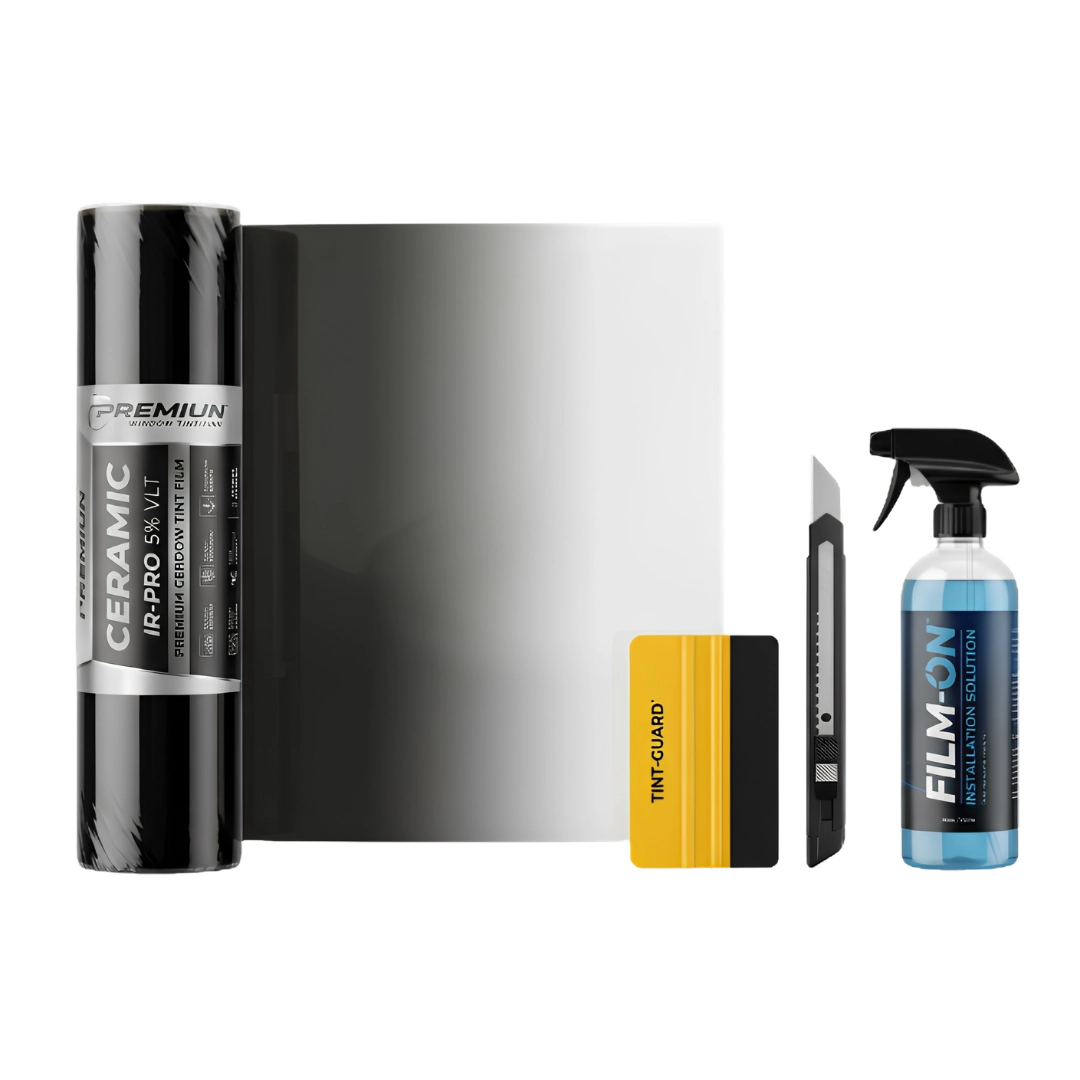
Ceramic film uses non-conductive, non-metallic ceramic particles suspended inside the film. These particles target infrared wavelengths specifically. They reflect and absorb the near-infrared band, which causes most of the heat felt inside a parked car. At the same time, the film still lets visible light through at the stated VLT level. Because the particles are non-metallic, ceramic film does not interfere with GPS, cellular signal, or electronic toll systems. It also resists fading, since ceramic particles do not break down under UV the way organic dye does.

Symptoms

Why Audi Owners in Abu Dhabi Need Quality Window Film

Cabin temperature at pickup

A car parked in direct sun for several hours can reach interior surface temperatures well above ambient air temperature, and infrared rejection directly reduces how much of that heat transfers through the glass.

UV exposure on leather and dashboard trim

UAE sun intensity accelerates cracking and fading of interior leather and plastic trim, and UV-blocking film slows that degradation significantly.

Glare on low-angle winter sun

Sun angle during UAE winter months sits low on the horizon during commute hours, and glare reduction improves visibility even within the legal VLT band.

Signal reliant systems

Audi models depend on GPS navigation, mobile connectivity, and toll transponders. Non-metallic ceramic film avoids the signal attenuation that metalized film can introduce.

Resale presentation

Faded, bubbled, or peeling tint visibly ages a car's interior and exterior appearance, while intact ceramic film holds its optical clarity for years.

Parking without shade

Villa driveways and open-air office parking leave cars exposed all day, and steering wheels, seat leather, and dashboards absorb that heat directly without a rejection film in place.

Child and pet safety

Cabin temperatures climb fast in direct sun, and stronger infrared rejection slows that rise, buying valuable extra minutes in situations where every minute matters.

8 jobs covered

Audi Window Tinting Services at Our Abu Dhabi Workshop

Full Vehicle Tint Package

Front side, rear side, and rear windshield are tinted together at a matched 50 percent VLT, giving a uniform appearance across every window while staying within the legal limit.

Ceramic Nano-Ceramic Film Installation

Non-metallic ceramic film is fitted using a wet application method, which allows the film to be positioned accurately before the adhesive cures and bonds permanently to the glass.

Legal Windshield Sun Strip

A UV-blocking strip is applied across the top edge of the windshield within the permitted height, cutting glare from low sun without breaching windshield tint law.

Rear Windshield Tinting with Defroster Care

Rear glass on most Audi models carries embedded defroster lines. Film is cut and fitted around these lines carefully, since heat gun misuse during fitting can damage the heating element.

Panoramic Sunroof Film

Where a UV and heat-rejection film is wanted on the panoramic roof glass, a clear or lightly tinted ceramic film is applied that meets the openable glass regulations rather than side window limits.

Old Tint Removal

Degraded dyed film, identified by a purple discolouration, bubbling, or peeling edges, is removed cleanly along with old adhesive residue before new film is applied.

Tint Bubbling and Peeling Repair

Failed film, usually from poor original adhesive quality or improper curing, is stripped and replaced rather than patched, since a repaired section never matches the surrounding film's optical clarity.

VLT Compliance Check

Existing tint on a used or imported Audi is measured with a calibrated VLT meter and compared against the legal limit before any other work proceeds.

Why us

Why Choose Zenfo Auto Services for Audi Window Tinting

Ceramic Film, Not Dyed

We fit non-metallic ceramic film as standard, which rejects far more infrared heat than dyed film and will not interfere with GPS, mobile signal, or toll transponders.

VLT Verified on Every Window

Each window is checked with a calibrated meter before the car leaves, giving you a compliant result confirmed by instrument rather than by eye.

Wet Application Method

Film is applied wet rather than dry, allowing accurate positioning before the adhesive sets, which reduces trapped air bubbles and edge lifting later.

Defroster Lines Respected

Rear windshield fitting accounts for embedded heating elements, avoiding the heat gun damage that causes defroster failure after a careless tint job.

Written Fitting Warranty

Film and installation carry a written guarantee against bubbling, peeling, and adhesive failure, so a fault traced to fitting or material returns to us at no cost.

Legal Compliance Documented

You receive confirmation of the VLT reading applied to each window, giving you evidence of compliance if ever questioned at a checkpoint.

Abu Dhabi climate

Why Abu Dhabi Conditions Make Film Choice Matter

Sustained high UV index

UAE sun intensity accelerates cracking and fading of interior leather and plastic trim, and UV-blocking film slows that degradation significantly.

Extreme parked cabin heat

A car parked in direct sun for several hours can reach interior surface temperatures well above ambient air temperature.

Dye breakdown under UV

Dyed film fades over time, since UV exposure breaks down the dye molecules, and that process runs faster under UAE sun than in milder climates.

Signal dependent systems

Metalized film can weaken GPS reception, mobile signal, and toll transponder communication, which matters more each year on connected Audi models.

Open-air parking as the norm

Villa driveways and open-air office parking leave cars exposed all day without shade.

Checkpoint enforcement

Police checkpoints use handheld VLT meters that read light transmission in seconds, so film darkness matters as much as film quality.

6 stages

How We Fit Window Tint on Your Audi

01

VLT and Vehicle Check

Every window is measured for existing tint, and the vehicle's glass type and curvature are noted, since panoramic and complex-curved glass need different fitting techniques.

02

Film Selection

VLT percentage and film type are confirmed against legal limits and your priorities, whether that is maximum infrared rejection, cost, or a specific finish.

03

Glass Cleaning

Each window is cleaned and decontaminated thoroughly, since any trapped dust or fibre beneath the film becomes a permanent visible defect once cured.

04

Precision Cutting and Fitting

Film is cut to match each window's exact curvature using a plotter pattern or hand-trimmed method, then positioned wet so it can be adjusted before final placement.

05

Squeegee and Heat Forming

Excess water and air are worked out from the centre outward, and heat is applied where needed to shrink film around curved glass sections without stressing the adhesive layer.

06

Cure Time and Final Check

Film is left to cure and bond fully before the car is released, and every window is rechecked with a VLT meter to confirm compliance before handover.

Free inspection slot

Book Your Audi Window Tinting in Abu Dhabi

We measure every window with a calibrated meter before you leave, so you know exactly what percentage is fitted and that it holds up at a checkpoint. Book Audi repair in Abu Dhabi online, or call Zenfo Auto Services for a tinting slot this week.

FAQ

Frequently Asked Questions

Front side windows, rear side windows, and the rear windshield can be tinted up to 50 percent VLT. The front windshield must stay clear except for a narrow sun strip across the top, usually no more than 10 to 15 cm.

Fitting film darker than 50 percent VLT breaks UAE federal traffic law, no matter how it performs. Checkpoints use calibrated meters, and non-compliant tint brings a fine and an order to remove or replace it.

Ceramic film rejects far more infrared heat than dyed film at the same VLT percentage. It also resists fading and does not interfere with GPS or mobile signal. For a car parked outdoors often in Abu Dhabi, the heat rejection difference is easy to feel.

Non-metallic ceramic film does not interfere with signal reception. Metalized film can weaken GPS, cellular, and toll transponder signals, which is one reason we fit ceramic film as standard.

A full vehicle tint package usually takes 3 to 4 hours. The film then needs several days to cure fully. During that time, keep the windows up and avoid cleaning them.

We strip degraded film along with the old adhesive residue, then fit fresh film. Patching a failed section never matches the optical clarity of the surrounding original tint.

Correct fitting avoids defroster damage entirely. We cut and place film around the heating elements, and we use heat guns carefully during forming to avoid overheating the embedded lines.

Panoramic roof glass can be treated with a UV and heat-rejection film, though it falls under separate rules to side windows, since it is openable glass rather than a fixed viewing window.