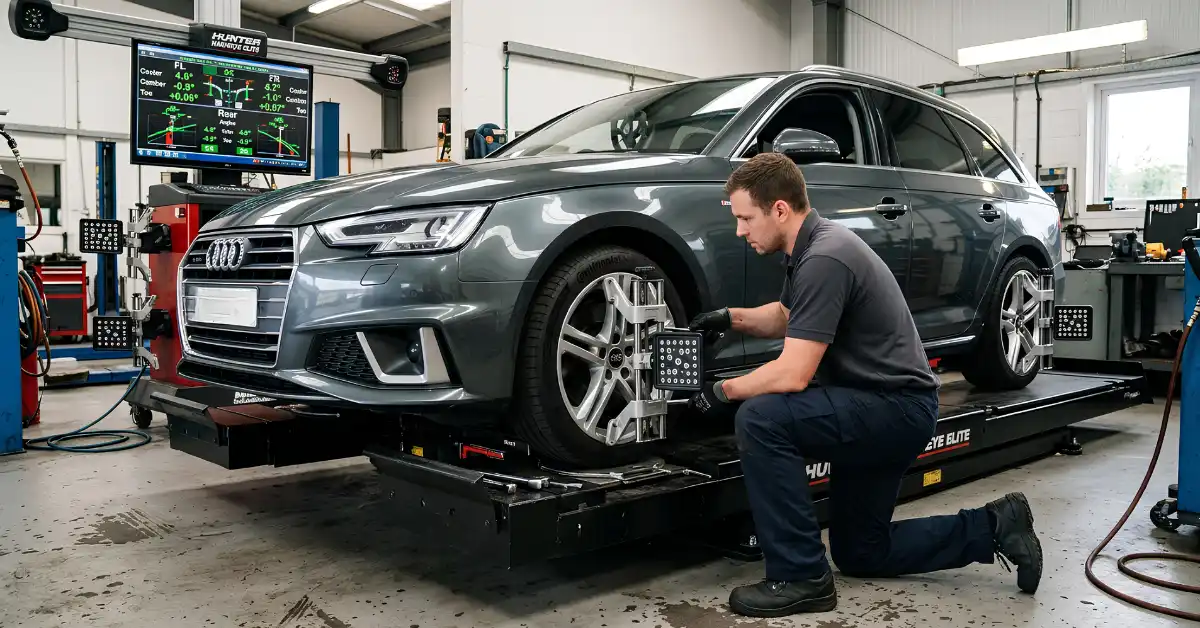
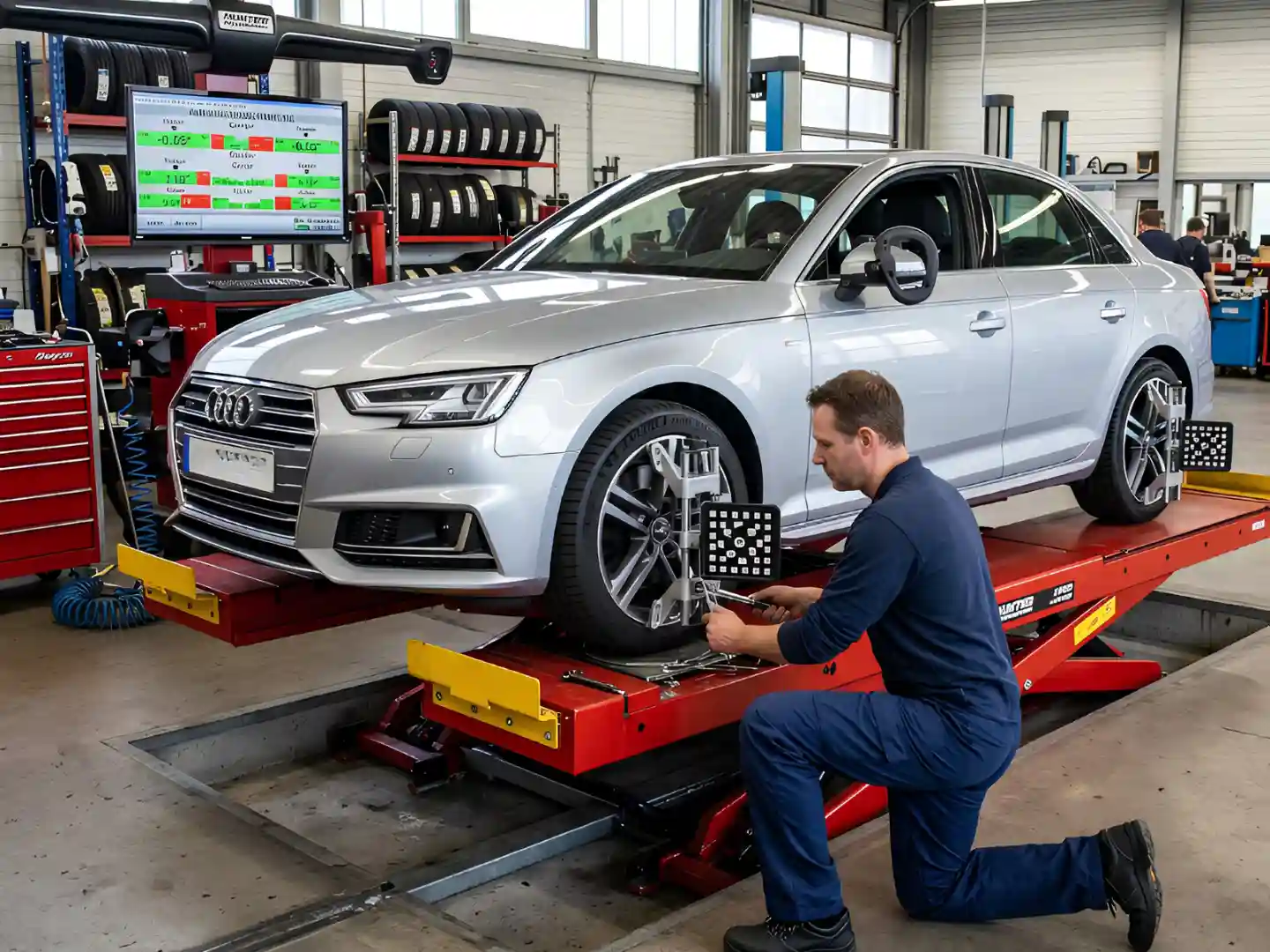
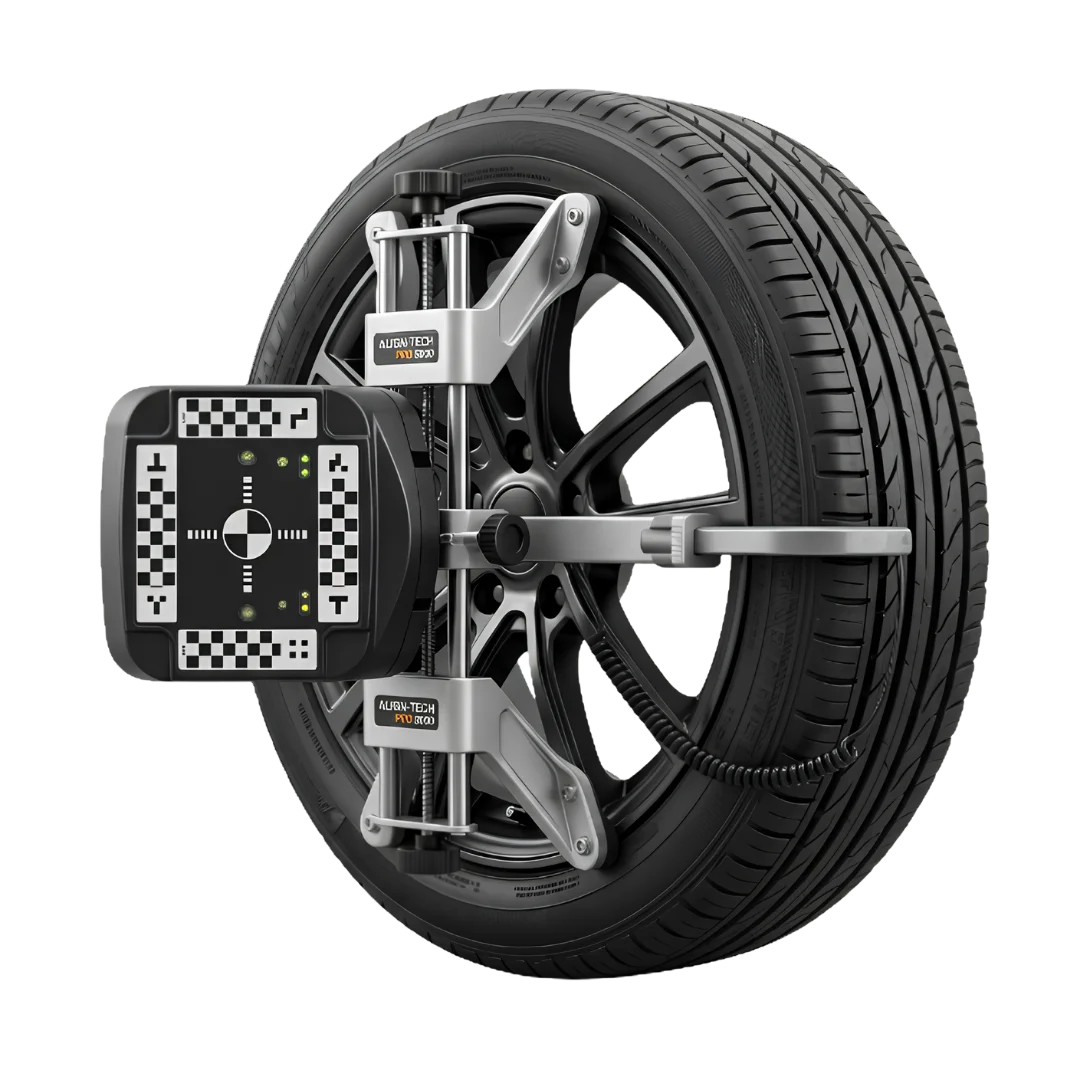
Zenfo Auto Services corrects camber, caster, and toe on Audi models in Abu Dhabi. We use a laser-guided four-wheel alignment rig. Every angle is measured against the specification for your exact chassis code. We adjust it to the preferred setting and print a before-and-after report.
Wheel alignment adjusts three angles. Each one is measured in degrees. Each one affects the car in a different way.
Camber
Camber is the inward or outward tilt of the wheel, seen from the front of the car. Negative camber tilts the top of the wheel inward. Positive camber tilts it outward. Audi sets a narrow negative camber range on most models. This balances tyre wear against cornering grip. Camber that drifts too far negative wears the inner tyre shoulder first.
Caster
Caster is the forward or backward tilt of the steering axis, seen from the side. It only exists on the front axle. There is no rear equivalent. Most modern Audi models run positive caster. This improves straight-line stability and helps the steering self-centre after a turn. Caster rarely drifts on its own. It usually only changes after a collision bends a control arm or strut tower.
Toe
Toe describes which way the wheels point compared to the car's centreline, seen from above. Toe-in means the fronts of the tyres angle toward each other. Toe-out means they angle apart. Audi specs usually call for a small amount of toe-in at the front. This is measured in fractions of a degree, or in minutes, where 60 minutes equals one degree. Toe is the angle most sensitive to daily driving. A single kerb strike can shift it right away.
A fourth reading, thrust angle, compares the direction the rear axle points against the car's true centreline. A non-zero thrust angle makes the steering wheel sit off-centre, even when the front toe is set perfectly. It always traces back to the rear axle.
Symptoms
Signs Your Audi Needs a Wheel Alignment
Pulling to one side on a flat, level road
Uneven camber or caster between the left and right wheels creates a consistent drift that steering correction has to fight constantly.
Steering wheel off-centre when driving straight
This points at incorrect toe or, if the car tracks straight while the wheel sits crooked, a non-zero thrust angle from the rear axle.
Uneven tyre wear across the tread
Feathered edges point to toe error, while wear concentrated on the inner or outer shoulder points to camber outside specification.
Vibration or wander at highway speed
Alignment error compounds with worn suspension bushes, and the combination shows up first at higher speeds where small angle errors have more effect.
Recent kerb strike or pothole impact
A single hard impact can bend a track rod or shift a subframe enough to change toe immediately, well before any wear pattern develops.
New tyres fitted without an alignment check
Fitting tyres onto a misaligned car guarantees the new set wears exactly like the old one did.
10 jobs covered
Audi Wheel Alignment Services at Our Abu Dhabi Workshop
Alignment work covers 10 distinct services here, because the angles themselves are only half the job.
Four-Wheel Laser Alignment
All four wheels are measured and adjusted together rather than the front axle alone, since rear toe and thrust angle affect how the front axle has to compensate.
Camber Correction
Where the suspension design allows adjustment, camber bolts or eccentric cams are used to bring the angle back within the specified range for your chassis and suspension type.
Caster Adjustment
The caster is checked on both sides and balanced, since an unequal caster between the left and right wheels causes a pull even when both sides individually sit within range.
Toe Setting, Front and Rear
Track rods and rear toe links are adjusted to bring both individual and total toe within specification, with the steering wheel centred as the final step.
Thrust Angle Correction
Rear axle geometry is measured against the car's true centreline. A non-zero thrust angle is corrected at the rear before the front toe is finalised, since front adjustment cannot fix a rear-axle problem.
Steering Wheel Centring
After the toe is set, the steering wheel position is checked and corrected so it sits level when the car travels in a straight line, a step frequently skipped elsewhere.
Ride Height Measurement
Alignment specifications assume a specific ride height. Sagging springs or aftermarket lowering shift the geometry, so height is measured and factored into the target angles before adjustment.
Suspension Component Inspection
Track rod ends, ball joints, control arm bushes, and subframe mounts are inspected before adjustment, since worn components make an alignment impossible to hold.
Post-Collision Geometry Check
Cars arriving after an impact receive a full geometry check across all measurable points, identifying bent components that adjustment alone cannot correct.
Alignment Report and Printout
Every job produces a before-and-after printout showing each angle against its specified range, giving you documented proof of the work performed.
Why us
Why Choose Zenfo Auto Services for Audi Wheel Alignment
Chassis Specific Targets
Specifications are pulled by chassis code rather than a generic vehicle category, since camber and toe ranges differ between suspension variants of the same model.
Four-Wheel Measurement
Front and rear axles are measured together, because rear toe error and thrust angle change what the correct front toe setting actually needs to be.
Suspension Checked First
Worn track rod ends or bushes are identified before adjustment begins, since setting angles against loose components produces a reading that will not hold beyond a few hundred kilometres.
Ride Height Factored In
Specified angles assume a defined ride height, so height is measured and accounted for rather than adjusting blind against a car sitting outside its design position.
Documented Before and After
Every job leaves you with a printed report showing measured angles against specification, giving evidence of the correction rather than a verbal assurance.
Thrust Angle Corrected Properly
Rear geometry is set before the front toe is finalised, avoiding the common shortcut of centring the steering wheel without addressing a crooked rear axle underneath it.
Abu Dhabi climate
Why Alignment Drifts Faster on Audi Models in Abu Dhabi
Deep potholes and speed bumps
Sudden impacts load the suspension asymmetrically and are common on service roads and construction zones around the city.
Kerbing during tight parking manoeuvres
Multi-storey car parks and narrow bay widths increase the frequency of light kerb contact that shifts toe incrementally.
Heavier factory wheel and tyre packages
S-line and larger wheel options on Q-series models add unsprung weight that accelerates wear in the bushes and joints that hold alignment settings.
High speed highway driving
Sustained speeds on Sheikh Zayed Road and similar routes make even minor toe error noticeable through steering feel and tyre wear far sooner than city driving would.
Heat softened suspension bushes
Rubber bushes lose stiffness in sustained high temperatures, allowing small amounts of unwanted movement that shows up as gradual alignment drift.
Sand and grit in steering and suspension joints
Contamination accelerates wear in track rod ends and ball joints, the same components that hold toe and camber settings in place.
Reference
Reading Tyre Wear as an Alignment Diagnosis
Tyre wear patterns record alignment history the way rings record a tree's age. A trained eye can often name the angle at fault before the car even goes on the rack.
Wear pattern
Likely cause
Wear concentrated on the inner shoulder
Too much negative camber, or toe-in beyond spec
Wear concentrated on the outer shoulder
Too much positive camber, or toe-out beyond spec
Feathered edges across the tread blocks
Toe error, front or rear, regardless of the camber setting
Even wear on both shoulders, centre worn less
Camber and toe are fine, tyre pressure is likely low
Centre of the tread worn more than the shoulders
Tyre pressure too high, not an alignment fault
Wear on only one front tyre, other side normal
Left-right camber or caster imbalance, or a bent part
Cupping or scalloped wear around the tread
Worn suspension or damper, often alongside alignment error
A tyre that already shows one of these patterns will not repair itself once alignment is corrected. The wear stays. But new tyres fitted after correction will wear evenly from that point on.
6 stages
Our Audi Wheel Alignment Process
Six stages, roughly 45 to 60 minutes for a straightforward setting, longer where correction or component replacement is needed.
01
Chassis Identification
Your VIN identifies the exact chassis code and suspension type, which determines the specified camber, caster, and toe ranges the alignment rig will target.
02
Suspension Inspection
Track rod ends, ball joints, bushes, and subframe mounts are checked before any adjustment, since alignment set against worn components will not hold.
03
Ride Height Check
Height is measured at all four corners before the car goes on the rack, since sagging springs or a lowered setup shift the geometry the specified angles assume.
04
Laser Measurement
Wheel-mounted sensors measure camber, caster, toe, and thrust angle simultaneously, comparing live readings against the target range for your specific chassis.
05
Adjustment
Camber bolts, track rods, and rear toe links are adjusted incrementally, with readings rechecked after each change until every angle sits within its specified range.
06
Verification and Report
Final readings are printed alongside the specified range for each angle, and the steering wheel position is confirmed centred before the car is released.
Free inspection slot
Book Your Audi Wheel Alignment in Abu Dhabi
Uneven tyre wear or a steering wheel that will not sit straight both point to angles worth measuring properly. A printed report shows you exactly what was out and what was corrected. Book Audi repair in Abu Dhabi online, or call Zenfo Auto Services for an alignment slot this week.
A check every 15,000 to 20,000 km, or whenever you fit new tyres, catches drift before it causes uneven wear. A hard kerb strike or pothole hit calls for a check right away, no matter the distance covered.
02
Alignment adjusts the angles the wheels sit at, relative to the road and to each other. Balancing corrects weight distribution around the wheel and tyre. A car can need one without the other. Vibration at speed usually points to balancing, not alignment.
03
Camber and toe outside spec wear tyres unevenly and cut their life short. Toe error causes feathered wear across the tread. Camber error concentrates wear on one shoulder.
04
A ride height change shifts the geometry the suspension works at, which moves camber and caster away from the standard figures. Lowered cars often need alignment set to a different target range than a standard ride height car.
05
A crooked steering wheel with straight tracking usually points to a non-zero thrust angle at the rear axle. Fixing the rear geometry first, then centring the wheel, solves this properly instead of just masking it.
06
Alignment fixes pulling caused by a camber or caster imbalance between the left and right wheels. Pulling caused by uneven tyre pressure, a dragging brake caliper, or the road's own camber will not be fixed by alignment alone.
07
It depends on the suspension design. Some Audi platforms come with eccentric camber bolts as standard. Others need aftermarket adjustable parts if the camber sits outside range and needs correcting.
08
A reading that will not move into range usually means a bent part, not an adjustment limit. We inspect track rods, control arms, and subframes, and identify any bent part before trying to adjust further.









 Audi specialist service